
Understanding crypto taxation in South Africa in 2024 and the taxation associated with crypto gambling. We look at income tax and capital gains taxes applicable to types of cryptocurrency transactions and the reporting criteria for SARS tax returns.
Navigating the exciting world of online casinos and sports betting in South Africa is new to many gamblers who have spent most of their time in land-based venues like Sun City. To spice things up, there is now also the necessity to learn the implications of cryptocurrency taxation—after all, no one wants to run foul of the local revenue services after landing a big win.
We will examine what you need to know about crypto gambling taxation in South Africa, whether you play live dealer games or bet on the Boks. We will cover the basics of crypto taxation, reporting criteria, how to limit your tax liability, and where crypto gambling winnings fit into the equation.
When it comes to crypto taxes in South Africa, any relative novice must understand the basics. As a responsible South African taxpayer, it's crucial to report any taxable gains or income from your crypto assets to the South African Revenue Service (SARS).
SARS officially recognises cryptocurrencies as “crypto assets, " not virtual currency, as evident in their ITR12 (Income Tax Return).
As per the South African Revenue Service website:
“According to the Explanatory Memorandum on the Taxation Laws Amendment Bill as issued on 20 January 2021 the word “cryptocurrency” was replaced with “crypto asset” in line with the proposed adoption of a uniform definition of crypto assets within the South African regulatory framework.”
Crypto assets are included under the definition of a “financial instrument” under section 1(1) of the Income Tax Act, No. 58 of 1962 (ITA). Also known as digital or virtual assets, crypto assets are a form of digital currency that relies on cryptography for security.
SARS recognises the following as crypto assets:
Crypto assets can be used for various applications, from payments and remittances to decentralised finance (DeFi).
The South African Revenue Service (SARS) treats cryptocurrencies as "assets of an intangible nature" and not currency or property. This means that, depending on their use, they are subject to capital gains tax (CGT) or income tax.
The tax on crypto in South Africa depends on the specific transaction, the tax that applies, and your earnings.
The nature of your crypto activities determines whether these are capital gains or income.
Disposals of crypto may be subject to capital gains or normal income tax, depending on the motive behind the investment - SARS may view persons who hold crypto assets as either traders (taxed on revenue income) or investors (taxed on capital gains).
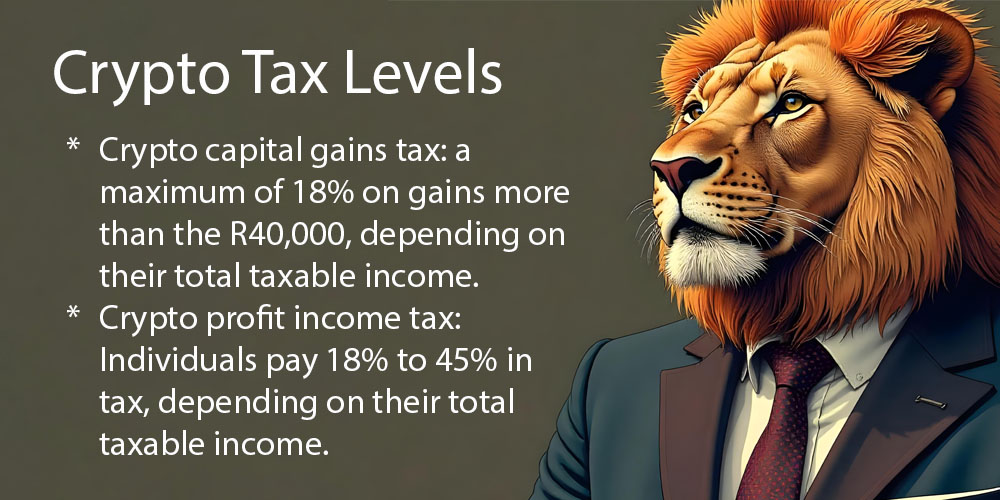
Traders are taxed on their entire crypto profits at the standard applicable tax rates depending on their income bracket. They can deduct allowable expenses before calculating and paying taxes owed.
By contrast, investors have an annual exclusion of R40,000. They are taxed at the standard applicable tax rates according to their income tax bracket, but only on 40% of any gain once the annual exclusion is applied.
The considerable difference in how gains are taxed when perceived as an investor and not a trader makes it more favourable for taxpayers.
Short-term active dealings often lead to income tax, whereas long-term, passive gains usually face capital gains tax. Considering the complexity, seeking advice from a crypto-savvy tax advisor is advisable to ensure more specific guidance.
Understanding when each tax year commences and ends and when your filing is due is essential for keeping track of which gains fall into which year.
The South African tax year runs from March 1st to February 28th of the following year.
The non-provisional tax deadline is 21 October 2024, and the provisional tax deadline is 20 January 2025.
In South Africa, you will pay Capital Gains Tax (CGT) on crypto when you dispose of your crypto assets at a profit.
A crypto disposal can occur in several ways:
In South Africa, you pay income tax on crypto when you realise a gain or receive income from your crypto assets. If your transactions are considered trades, all profits from cryptocurrency disposals will be regarded as income and taxed accordingly.
In addition, the following transactions will be subject to income tax regardless of whether you are in the trader or investor category:

SARS has been granted a wide range of collection powers in terms of the Income Tax Act, including a requirement for third-party service providers to submit financial data if called upon - both locally and abroad.
SARS can access your data if you have an account with a South African cryptocurrency exchange like Luno. If you trade on an overseas exchange, rest assured—they'll also attempt to track that information.
So, if you’re considering outright avoidance of your crypto tax obligations - don’t. The penalties for tax evasion in South Africa are steep.
Fortunately, not all crypto transactions in South Africa are taxable. SARS will tax you only when you earn additional income or dispose of a crypto. This means that some transactions are tax-free, including the following:

For those using their Bitcoin for online activities, like playing on the best crypto casinos in South Africa, it's important to note that any wins from these online platforms may also be taxable.
Whether you’re earning from crypto gambling, trading or mining, you must accurately report your crypto earnings to avoid penalties.
In South Africa, earnings from crypto gambling are subject to standard income tax rules, meaning that any winnings from crypto gambling must be declared as part of your taxable income.
The South African Revenue Service treats cryptocurrencies as assets of an intangible nature, so the same rules that apply to other forms of income also apply to Bitcoin gambling.
It's vital to keep a detailed record of all your transactions, including dates, venues, values and any gains or losses, to ensure accurate reporting and compliance with tax regulations.
This is especially important if you're cashing out winnings from online platforms. Tax implications vary depending on how often you engage in these online activities and whether the earnings are part of a hobby or a business.
Occasional gambling and lottery winnings are not subject to capital gains tax, but frequent gambling activities that generate regular income are taxable and must be declared to SARS.
"Did You Know: A new 15% withholding tax on gambling winnings exceeding R25,000 will be implemented in the country in 2025."
With the government carving this new path to revenue generation, including National Lottery payouts and online casinos, it is compelling for South Africans to understand the gambling tax implications of their windfalls.



 Blackjack
 Roulette
 Craps
Craps Slots
Slots Baccarat
 Poker
Poker